
If you feel like your social results have quietly slid over the last 12 to 24 months, you are not imagining it.
For a lot of B2B teams, the default “efficiency” play is still posting the same content on all social media platforms: write one caption, ship it everywhere, hope distribution does the rest. That used to be “good enough” when organic reach was forgiving and audience overlap was smaller.
Now it underperforms because cross-posting is not “one audience, many places.” It is the same buyer, in different modes.
The attention landscape is also more fragmented than it has ever been. DataReportal, citing GWI data, reports that the typical social media user visits an average of 6.75 platforms per month and spends 18 hours and 36 minutes per week across social networks and video platforms. That matters because your buyer is encountering your message in multiple contexts, with different expectations, and different “rules of the room.”
This article gives you a B2B-ready system to adapt one idea into platform-native executions without turning your team into a content factory. You will get:
- A clear explanation of why copy-paste fails now (without blaming mysterious algorithms)
- A repeatable repurposing framework you can run every week
- Platform-specific examples for LinkedIn, X, YouTube, short video, communities, and email/newsletters
- A minimum viable customization approach for stretched teams
- What “Posting the Same Thing Everywhere” Actually Means (and why teams do it)
- The 5 Reasons It’s Failing Now (Not “Because Algorithms Hate You”)
- The Fix: One Idea → Many Native Executions (The B2B Repurposing System)
- Concrete B2B Examples: Same idea, different platform-native versions
- When Cross-Posting Does Work (so we stay honest)
- B2B Measurement: What to track per platform (so “native” stays accountable)
- Quick-Start Checklist for busy B2B teams
- Conclusion: Stop copy-pasting posts, start translating buyer intent
- FAQ
What “Posting the Same Thing Everywhere” Actually Means (and why teams do it)

Let’s name the behaviors, because “repurposing” gets used loosely.
Cross-posting is sharing essentially the same post across multiple platforms with minimal changes. Buffer defines cross-posting as the practice of sharing the same content across multiple social media platforms. Bitly frames it similarly: one piece of content distributed to multiple channels, with only minor formatting changes.
Multi-posting typically refers to the operational act of publishing to multiple platforms, often via a tool or dashboard. It is about distribution mechanics more than content fit. Bitly’s cross-posting guide is a good example of how the term is often discussed alongside workflows and tooling.
Repurposing is transforming a core idea so it fits the norms, formats, and user intent of each platform. It can start from the same source, but the execution changes.
Why do B2B teams default to cross-posting?
Because it is rational in a resource-constrained world.
Mailchimp calls out the appeal clearly: cross-posting can save time and maintain brand consistency, but it also introduces problems like audience redundancy and platform limitations if content feels repetitive. Most B2B marketing orgs are balancing pipeline goals, product launches, sales requests, webinars, and content production with small teams. Cross-posting feels like a responsible compromise.
The issue is not that efficiency is wrong.
The issue is that the old efficiency tactic now creates a performance tax.
The 5 Reasons It’s Failing Now (Not “Because Algorithms Hate You”)
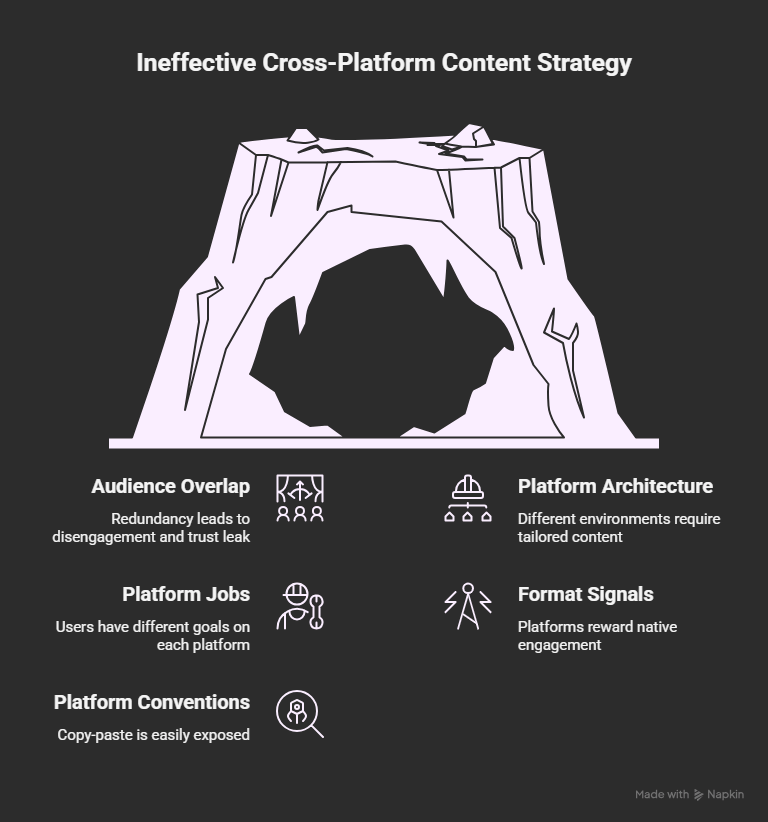
You will hear plenty of advice like “tailor per platform” and “algorithms changed.” True, but incomplete.
What actually changed is the combination of user behavior and platform mechanics. Here are five reasons posting the same thing everywhere is failing now, explained in ways you can operationalize.
1) Audience overlap creates redundancy fatigue
In B2B, your audience overlap is not theoretical. The same finance leader who sees you on LinkedIn also subscribes to newsletters, watches YouTube explainers during research, and scans X when something breaks in the industry.
When you repeat the same post in the same framing across platforms, it reads as low-effort and causes disengagement. Mailchimp explicitly warns about audience redundancy and the risk of followers disengaging when content feels repetitive.
B2B buyers are also disproportionately sensitive to effort signals. If the message looks copy-pasted, the subconscious conclusion is: “They did not invest in understanding this channel, so they probably will not invest in understanding me.”
Redundancy fatigue is not just boredom. It is a trust leak.
2) Platform architecture changes what people notice, trust, and share
Each platform is not just a different audience pool. It is a different environment with different default behaviors:
- Feed-first platforms reward instant comprehension and emotional clarity.
- Search-first platforms reward depth, structure, and demonstrations.
- Community-first spaces reward specificity, humility, and peer-first value.
When you post the same thing everywhere, you ignore architecture. And architecture determines distribution.
A LinkedIn post is judged inside a feed where people expect professional perspective and peer conversation. A Reddit thread is judged inside a community where self-promotion norms can be strict and context matters. Reddit’s own guidance has long emphasized that self-promotion is generally frowned upon and you should understand the culture and norms.
Same message, different architecture, different outcome.
3) Each platform is used for a different “job”
This is the single most useful mental model for B2B teams.
Your buyer is not “on social.” They are using platforms to accomplish different jobs, often in different moments of their day:
- Skim and keep up with industry reality
- Sense-check an opinion
- Learn how something works
- Validate a vendor category
- Ask peers what they did
- Be entertained during a break
Salesforce’s B2B social media marketing guide frames social as a way to reach buyers and decision makers across multiple channels, reinforcing that B2B attention is multi-platform.
When you copy-paste, you force one job onto every platform.
Better approach: match the execution to the job the user hired that platform to do.
4) Format-native signals influence distribution
Even if you ignore algorithms, you cannot ignore incentives.
Platforms distribute what keeps users engaged on-platform. That means formats and behaviors that increase time spent, interaction depth, and repeat engagement tend to get rewarded.
On LinkedIn specifically, recent strategy commentary consistently emphasizes meaningful engagement and dwell time. Emfluence notes that LinkedIn prioritizes posts that spark conversation and that dwell time matters, with formats like native documents and short videos often outperforming simple links and reshares.
If your cross-post is a link-heavy caption copied from elsewhere, it often carries the wrong signals for that platform.
The point is not to “game” the system. The point is to publish in a way that the platform can actually understand and distribute.
5) Platform limitations and conventions expose copy-paste instantly
Every platform has conventions that make copy-paste obvious:
- Character limits and truncation behaviors
- Hashtag norms
- Link handling
- Tagging etiquette
- Visual formats and aspect ratios
- Caption length expectations
- CTA expectations (comment vs click vs reply)
Mailchimp mentions platform limitations as a key risk in cross-posting. Iconosquare’s cross-posting best practices also emphasize customizing captions, formatting media correctly, and not scheduling everything at the same time.
Copy-paste is not just suboptimal. In many cases, it is visibly “wrong” for the environment.
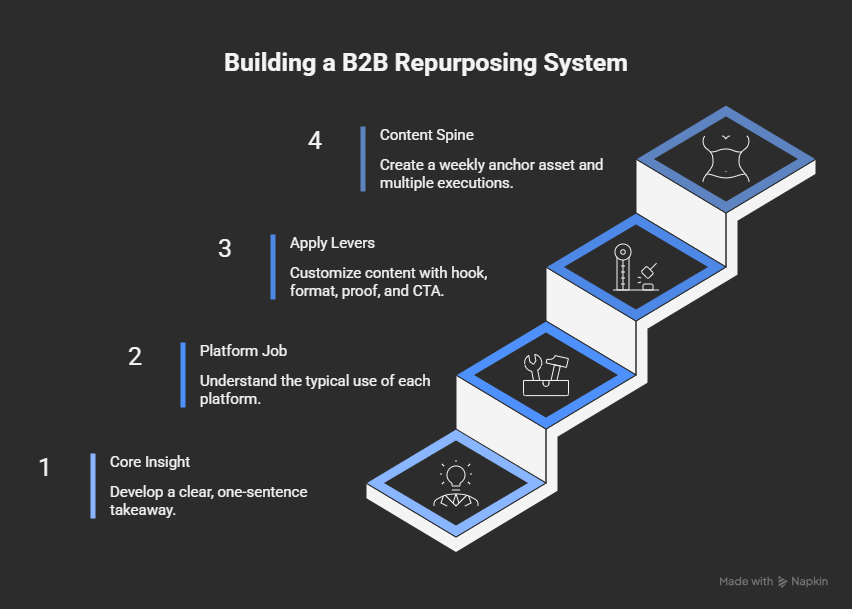
The Fix: One Idea → Many Native Executions (The B2B Repurposing System)
Most advice ends at “tailor it.” That is not a system.
Here is a repeatable framework you can run weekly, even with a small team:
Core Insight → Angle → Format → Hook → Proof → CTA → Conversation
You will notice this does not start with “make a post.” It starts with what you want the buyer to believe or do.
Step 1: Start with a Core Insight (not a “post”)
A core insight is a one-sentence takeaway that could survive without formatting.
Use this structure:
- What changed
- Why it matters
- What to do next
Example core insight for this article:
“Cross-posting is underperforming because the same buyer uses each platform for a different job, so you need platform-native repurposing, not copy-paste distribution.”
If you cannot write the insight in one sentence, the content is probably too fuzzy to repurpose efficiently.
Step 2: Map the Platform “Job”
Now decide what job your buyer is doing on each channel. This is the fastest way to avoid generic “best practices” and make practical decisions.
| Platform | Primary job (typical B2B use) | What wins | What to change first |
|---|---|---|---|
| Credibility + perspective | POV + proof + discussion | Hook, structure, prompt | |
| X | Compression + commentary | sharp take + threadable logic | phrasing, punch, cadence |
| YouTube | Demonstration + depth | examples + clarity | script, pacing, visuals |
| Short video (TikTok/Reels/Shorts) | Pattern interrupt + clarity | one idea + one example | first 2 seconds, captions, delivery |
| Communities (Reddit/Slack) | Peer validation + troubleshooting | honesty + specificity + usefulness | frame as a question or lesson, reduce promotion |
| Email/newsletter | Trust + retention | narrative + curated links + reply | subject line, intro, segmentation |
This table is intentionally simple. You are not trying to become a creator on every platform. You are trying to respect what the platform is for.
Step 3: Apply the “4 Levers” (minimum viable customization)
If your team is stretched, you do not need six unique campaigns. You need four small changes that create disproportionate gains:
- Hook
The first line, first screen, or first 2 seconds must fit the platform’s scanning behavior. - Format
Thread vs single post vs carousel vs video vs question-led community post. - Proof
A stat, a quick example, a mini case, a screenshot, a “before/after.” Proof is what makes a B2B post feel real. - CTA
Match the desired action to the platform: comment, save, reply, DM, click, subscribe.
Iconosquare’s guidance about customizing captions, media formatting, and timing aligns with this “minimum viable customization” approach.
Step 4: Build a “content spine” for the month
This is how you scale without burning out.
A practical cadence many B2B teams can sustain:
- 1 anchor asset per week (webinar, case study, report, customer story, pillar blog, product teardown)
- 6 to 12 native executions from that anchor across your chosen platforms
If you only have capacity for three platforms, that is fine. The spine still works.
A good operating model is:
- 2 home platforms (where you build compounding audience)
- 1 outpost platform (where you test and harvest learnings)
Concrete B2B Examples: Same idea, different platform-native versions
Let’s take one idea and “translate” it.
Example idea: “Your cross-posting is underperforming because you are catching the same buyer in different modes.”
LinkedIn (credibility + perspective)
Format: Carousel or native document (8 slides)
Slide flow:
- Title: “Cross-posting is not a strategy anymore”
- “Same buyer, different mode” explanation
- The 5 reasons it fails (one per slide)
- The 4 levers of minimum customization
- Simple prompt: “Which platform feels hardest for your team right now?”
Caption hook options:
- “Cross-posting worked when attention was simpler. It is failing because buyers are multi-platform now.”
- “If you are posting the same thing everywhere, you are training your audience to ignore you.”
CTA: “Comment ‘NATIVE’ and I’ll send the one-idea-to-six-posts template.”
Why this works: LinkedIn often rewards conversation and dwell time, and native formats that hold attention can outperform simple link reshares.
X (compression + commentary)
Format: 7-tweet thread
Tweet 1: “Posting the same thing everywhere is failing for one reason: the same buyer uses each platform for a different job.”
Tweets 2 to 6: One reason each, written with punch and specificity:
- “Audience overlap creates redundancy fatigue.”
- “Platform architecture changes what gets noticed.”
- “Format-native signals affect distribution.”
- “Copy-paste exposes itself instantly.”
- “The fix is not more content. It is better translation.”
Tweet 7: “Minimum viable customization = hook + format + proof + CTA. If you do only one thing: write a platform-specific first line.”
CTA: “Bookmark this. Next week I’ll share a swipe file of hooks per platform.”
Short video (pattern interrupt + clarity)
Format: 35 seconds talking-head with text overlays
Script:
- 0 to 2s: “If you are posting the same content on all social media platforms, this is why reach is dropping.”
- 2 to 15s: “The same buyer uses each platform for a different job. LinkedIn is perspective. Communities are peer validation. Short video is clarity fast.”
- 15 to 30s: “So take one idea and change only four things: hook, format, proof, CTA.”
- 30 to 35s: “Want the checklist? Comment ‘CHECKLIST’.”
Edits: Tight cuts, big captions, one key example.
YouTube (demonstration + depth)
Format: 7-minute explainer
Structure:
- Problem and proof point (multi-platform behavior)
- 5 reasons cross-posting fails
- Walk through the platform job map
- Show one real example: how you rewrote the same idea into a LinkedIn carousel vs X thread vs newsletter intro
- End with a “30-day experiment” challenge
Include the DataReportal fragmentation stats early to frame why this is worse now.
Communities: Reddit or Slack (peer validation + troubleshooting)
Format: Question-led post with specifics
Reddit-style framing:
- Title: “B2B teams: what is your minimum viable customization per platform?”
- Body: “We tested copy-paste vs platform-native repurposing for 4 weeks. Copy-paste got impressions, but low comment depth and few qualified conversations. The best lift came from changing hooks and CTAs per platform. Curious how you handle this without tripling workload.”
CTA: Ask for experiences, not clicks.
Why this works: community spaces often punish drive-by promotion. Reddit’s guidance highlights that self-promotion is generally frowned upon and norms matter.
Slack communities also tend to channel promotion into specific places and value helpfulness over selling.
Newsletter (trust + retention)
Format: 400 to 700 words
Subject line options:
- “The copy-paste tax”
- “One idea, six executions”
Body:
- A short story about a stretched team posting everywhere
- The insight: “same buyer, different job”
- The 4 levers
- A link to your anchor asset (pillar blog, case study, or template)
CTA: “Reply with your home platforms and I’ll suggest the best ‘outpost’ to test.”
When Cross-Posting Does Work (so we stay honest)
Cross-posting is not evil. It is just overused as a default.
It can work when the goal is pure distribution of a time-sensitive or universal message, for example:
- Press mentions and awards
- Hiring announcements
- Event logistics
- Critical product announcements
- Security or incident updates
- Public statements
Even then, you should usually adjust the hook and CTA.
Buffer’s general guidance around cross-posting emphasizes adapting content to the platform, which is a good baseline principle even when you do share broadly.
Also, short-form video can travel cross-platform more easily than text, but only if you tweak the native details: captions, aspect ratio, and intro pacing.
B2B Measurement: What to track per platform (so “native” stays accountable)
Platform-native repurposing is not art for art’s sake. It should move measurable outcomes: awareness quality, trust signals, and demand capture.
Here are pragmatic metrics that align with typical B2B goals.
- Comment quality (are peers adding substance?)
- Saves (proxy for “this is useful”)
- Profile clicks and follower growth on target roles
- Conversation rate: comments-per-impression for POV content
LinkedIn distribution often correlates with meaningful engagement and dwell time style signals, so optimize for keeping readers engaged and prompting discussion.
X
- Bookmarks and follows per post
- Replies that indicate debate or agreement (not just emojis)
- Link clicks for BOFU threads, but do not force it on every post
YouTube and long video
- Average view duration and retention curve (where do viewers drop?)
- Comments that ask for follow-ups
- Clicks to your template or newsletter from pinned resources
Short video
- 3-second hold rate
- Average watch time and completion rate
- Comments that repeat your phrasing (signal that the idea landed)
Communities (Reddit/Slack)
- Comment depth and helpful replies
- Qualified DMs or inbound “can you share how you did that?”
- Invitations to expand on the topic (AMA, podcast, collab)
Newsletter
- Replies (trust metric)
- CTR on a single primary link
- Forward rate (harder to measure, but you can ask “forward this to one person” and track referrals)
Quick-Start Checklist for busy B2B teams
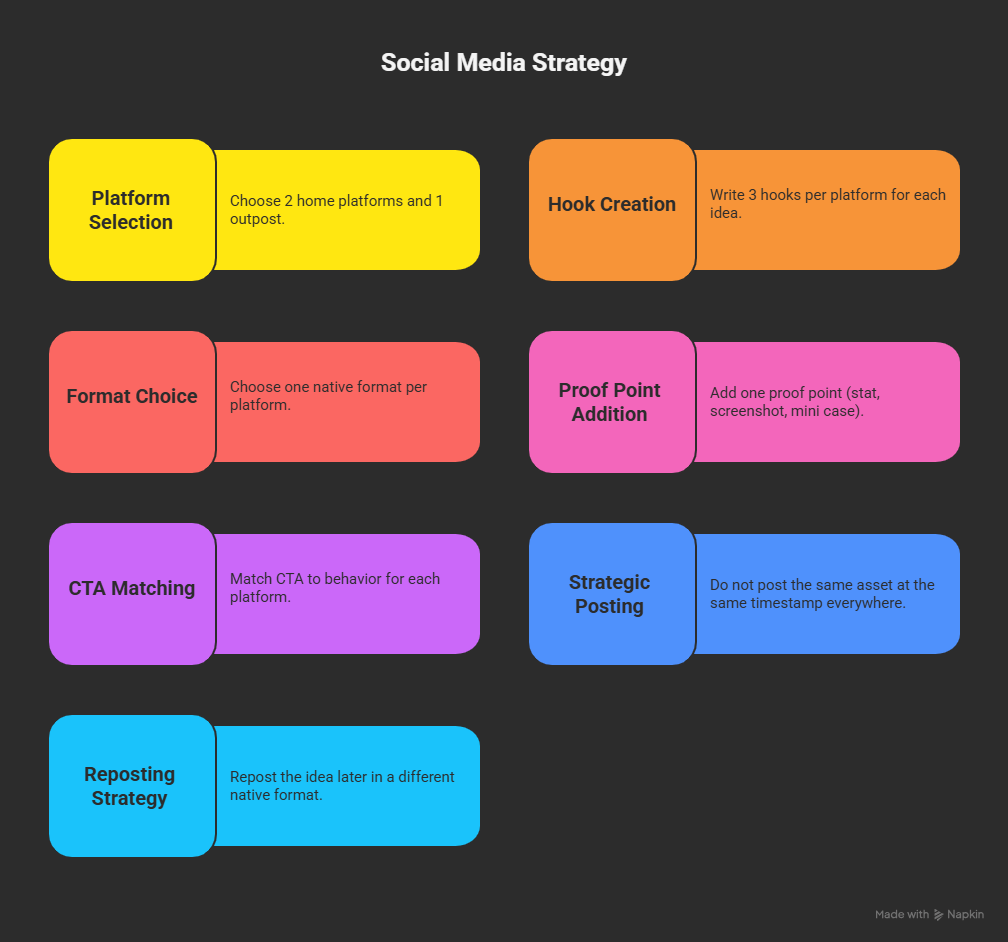
If you do nothing else, run this for 30 days.
- Pick 2 home platforms and 1 outpost
- For each idea, write 3 hooks per platform (yes, only hooks)
- Choose one native format per platform (carousel, thread, video, question post)
- Add one proof point (stat, screenshot, mini case)
- Match CTA to behavior:
- LinkedIn: comment or save
- X: bookmark or reply
- Video: comment keyword
- Community: respond with your experience
- Newsletter: reply with an answer
- Do not post the same asset at the same timestamp everywhere
- Repost the idea later in a different native format, not as a duplicate
Iconosquare explicitly advises being strategic about timing and avoiding over-automation, which supports this checklist approach.
Conclusion: Stop copy-pasting posts, start translating buyer intent
Posting the same content on all social media platforms is failing now because your buyer is multi-platform and context-driven. They are not seeing “more reach.” They are seeing repetition in different rooms, with different rules.
The fix is not to create six separate campaigns. The fix is a system:
- Define the core insight
- Map the platform job
- Pull the four levers (hook, format, proof, CTA)
- Build a monthly content spine so repurposing is scheduled, not improvised
If you want a simple next step: pick two home platforms and one outpost, then run the one-idea-to-six-executions workflow for 30 days. Use the results to decide where to double down.
Request a content repurposing audit (we’ll rewrite one post for three platforms)
Email me at contentwriter3851@gmail.com
FAQ
Is it bad to post the same content on all platforms?
It can be, especially when audience overlap is high and platforms have different norms. The common failure mode is redundancy fatigue, where followers disengage because content feels repetitive or not tailored. Mailchimp highlights these risks, including audience redundancy and platform limitations.
If you must cross-post, change the hook and CTA so the post feels native.
What’s the difference between cross-posting and repurposing?
Cross-posting distributes the same content across platforms with minimal changes. Repurposing transforms a core idea into platform-fit executions. Bitly’s definition of cross-posting emphasizes minimal adjustments, which is the contrast point. Repurposing is closer to translation than duplication.
What’s the difference between cross-posting and multi-posting?
Cross-posting is the content strategy choice (same post in many places). Multi-posting is the operational act of publishing to many places, often via tools. Many guides discuss these together because the workflow overlaps, but the content decision is what drives performance.
How much should I change when repurposing content?
Start with minimum viable customization: hook, format, proof, CTA. Iconosquare’s best practices emphasize customizing captions, formatting media correctly, and being strategic about timing, which are practical “small changes” that matter.
A good rule: if it looks copy-pasted to someone native to the platform, you did not change enough.
Does cross-posting hurt reach?
Not automatically. But cross-posting can underperform when the format and signals are misaligned with a platform’s distribution mechanics, or when audience redundancy causes disengagement. Mailchimp points to disengagement risk when repetition sets in, and emfluence notes the importance of engagement and dwell time style signals on LinkedIn.
What should be different on LinkedIn vs X vs Instagram-style short video?
- LinkedIn: perspective + proof + discussion prompt
- X: compression + commentary, often as a thread
- Short video: one idea + one example, delivered fast with strong captions
The “platform job” model is the simplest way to keep this consistent without overthinking.
Should B2B prioritize LinkedIn only, or go multi-platform?
LinkedIn is often the strongest B2B home base, but multi-platform behavior is now normal. Salesforce’s B2B social media marketing guide positions B2B distribution as multi-channel, reaching decision makers across platforms like LinkedIn, X, and YouTube.
The practical move is not “be everywhere.” It is “be excellent in two places, then test one outpost.”
What is the fastest way to improve results without adding headcount?
Stop shipping posts. Start shipping insights.
Write one strong core insight per week, then apply the four levers across your chosen platforms. You will feel the impact quickly because the first line and CTA changes alone can dramatically alter how people interact.
 Binny Agarwal