Most B2B SaaS content strategies fall into one predictable pattern. A team publishes blogs as fast as possible, chases vanity metrics, celebrates impressions, and then wonders why pipeline remains flat. The pattern made sense a decade ago when search visibility depended mostly on keyword targeting. It does not work in 2025. Buyers research across Google, AI Overviews, LinkedIn, YouTube, and product communities. Generative engines decide which brands appear as credible sources and which are ignored.
The shift is sharp. Content can no longer be written to satisfy algorithms or earn a ranking snapshot. It must be structured so both humans and generative engines recognize you as the best answer. This is the core of a GEO-first content strategy. Over the past several years I have helped Seed to Series B SaaS teams rebuild their content engines around this concept. Once they aligned jobs, pain, product, and proof, content finally started driving demos and not just pageviews.
This article distills that work into seven GEO-first plays inspired by top SaaS brands. You can adapt every one of them within the next 90 days. The goal is simple. Give you a B2B SaaS content strategy that is pipeline first, AI era ready, and grounded in real use cases instead of generic advice.
Use these plays as a blueprint, then adapt them to your ICP, motion, and category.
What GEO-First Actually Means for B2B SaaS Content
GEO stands for Generative Engine Optimization. It is the practice of designing content so that humans, search engines, and AI systems can all understand who you are, what you solve, and why your answer is the most credible. GEO-first is not keyword stuffing for chatbots. It is clarity plus structure plus proof.
A simple three-part framework helps anchor this idea.
Entity clarity
Make it explicit who you are, what your product does, and which segment you serve. Generative systems rely on entities more than traditional keywords. If you do not clearly express your product category, ICP, use cases, and outcomes, these systems struggle to link you to any scenario.
Structured depth
Organize content in a way that is fact dense and easy to parse. Use clean headings, examples, and short explanations. Include FAQs and scenario driven content. This is the material AI Overviews lift most often because it is legible and complete.
Outcome proof
Show real results with numbers, screenshots, and context. Proof is the multiplier that helps generative engines cite you instead of competitors. Proof is equally important for human buyers who need reassurance during long, multi stakeholder evaluations.
For B2B SaaS teams, GEO-first matters because your buyers navigate complex journeys. They read problem explainers, compare multiple solutions, talk to internal stakeholders, and try to reduce risk. Traditional top of funnel content rarely influences these moments. GEO-first content connects the dots from problem to product to proof in a way that satisfies evaluators and generative engines at the same time.
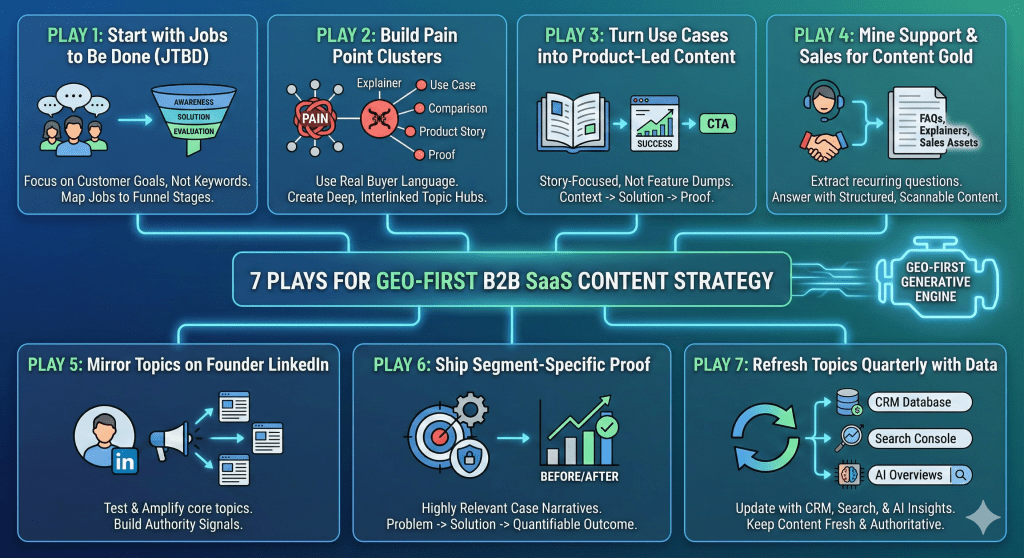
Play 1: Start with Jobs to Be Done per Segment (Not Topics or Keywords)
A modern B2B SaaS content strategy begins with jobs to be done. Most teams start with topics or keyword lists. GEO-first teams start with what specific customers are trying to accomplish.
Imagine three of your best fit segments. For example, RevOps leaders at Series B companies, product marketers inside PLG SaaS orgs, or data teams supporting customer success. Each segment has a handful of jobs that drive their decision making. These might include consolidating GTM data, reducing manual reporting time, or accelerating onboarding for new hires.
List the five most important jobs for each segment. Then map content ideas to each job across three layers of the SaaS funnel.
Early awareness
Help the buyer name the problem and understand its stakes.
Solution awareness
Clarify approaches, frameworks, or solution categories.
Product evaluation
Show how your product solves this job and why your method is superior.
For example, a RevOps SaaS platform might map the job consolidate GTM data into a sequence. Start with an article like how to audit your RevOps stack, follow with a breakdown of RevOps platform categories, then create a comparison page, and close with a product led walkthrough supported by a customer story.
The GEO-first angle is simple. When you state the job, the ICP, and the context directly, generative engines can associate your brand with the problem more accurately.
Try this in 2 weeks
Run 5 to 10 quick interviews with recent customers or sales leads. List their top jobs to be done. Convert each job into one or two content ideas that match each stage of the funnel.
Play 2: Build GEO-First Pain Point Clusters (Not Just Keyword Lists)
Traditional SEO workflows export long keyword lists and choose topics based on search volume. GEO-first content strategy flips that model. Instead of keywords first, you start with real buyer pain. The language that appears in Gong calls, support tickets, onboarding decks, and CRM notes is far more accurate than anything a keyword tool produces.
Collect phrases buyers use when they describe their struggles. Group them into pain clusters such as spreadsheet chaos, data silos, manual onboarding, or integration friction. For each pain cluster, design a complete topic hub that supports your B2B SaaS content strategy.
A strong pain point cluster includes:
Problem explainer
Use case breakdowns
Alternatives and comparisons
Product led stories showing how you solve the pain
Proof pieces or case style articles
This cluster structure helps both humans and AI systems understand the depth of your expertise. Generative engines especially prefer internally consistent clusters with repeated entities such as ICP roles, product category terms, and outcome types.
Try this in 2 weeks
Pick one high value pain. Design a cluster with four or five assets. Publish two this month and keep the rest in your next sprint.
Play 3: Turn Real Use Cases into Product Led Content, Not Feature Dumps
Product led content is one of the highest converting asset types in any B2B SaaS content framework. Unfortunately, many teams confuse product led content with feature tours. Real product led content focuses on the story of an ICP solving a job to be done with your product. The features appear in context, not as isolated bullet points.
Use this structure for your next product led article.
Context
Who is the buyer, what system or workflow is broken, and what creates urgency.
Old way vs new way
Describe the cost of the current state and then show how your product creates a better state.
Screenshots, flows, and specifics
Add detail about how the product fits into the workflow and what outcome it produces.
Outcome proof
Quantify time saved, errors avoided, or revenue impact.
Clear next step
End with a specific action such as a demo, a template, or a trial.
For example, a PLG onboarding tool might publish How onboarding managers use [Product] to reduce activation time by 40 percent. This gives generative engines entities they can connect to a known scenario. It also gives buyers a realistic preview of your capabilities.
Mid article CTA
Want a GEO-first content roadmap tailored to your pipeline and ICP. This is exactly what I build for B2B SaaS teams.
Try this in 2 weeks
Choose one customer story that already exists. Turn it into a product led article using the structure above.
Play 4: Mine Support Docs and Sales Calls as Keyword and Content Gold
Your support team and sales team are sitting on the most valuable content insights in your company. Support tickets reveal the questions that confuse users most often. Sales calls reveal the questions prospects ask before they commit. When you turn these into structured content, you reduce friction across the entire buying journey.
Start by reviewing:
Gong or Chorus recordings
Support ticket summaries
Implementation and onboarding documents
Slack threads between CSMs and product
Extract the recurring how, why, and what questions. Group them into themes such as pricing, integrations, onboarding, security, and outcomes. Then turn them into three types of content.
FAQ pages
Fast rankings and highly liftable for AI Overviews
Explainer posts
Short, clear explanations of concepts or steps
Sales enablement assets
Pages that answer objections and support reps
This process works incredibly well in a GEO-first content strategy. Questions and answers create clean, scannable structure. When paired with schema markup, they are easy for AI Overviews to surface as direct citations.
Try this in 2 weeks
Review ten recent support tickets and five sales calls. Build a list of twenty questions. Prioritize the top five. Ship one FAQ style asset before the end of the sprint.
Play 5: Mirror Your GEO-First Topics on Founder Led LinkedIn
A B2B SaaS content strategy fails when distribution is random. One of the fastest ways to test ideas and feed your strategy is to use founder or executive LinkedIn distribution. Top SaaS brands do this consistently. They echo the same topics from blog to social to podcast. This repetition builds authority signals for both humans and algorithms.
Take each GEO-first cluster and turn it into three to five LinkedIn posts. Do not summarize the entire article. Instead, pick a single angle or insight and package it for social. The engagement data will show you which ideas resonate, which narratives people repeat, and which objections surface. Use this input to refine your long form content.
This also strengthens entity clarity. When your founder repeatedly talks about your ICP, product category, and use cases, AI systems start linking your brand to those entities more reliably.
Try this in 2 weeks
Choose two clusters. Draft six to eight LinkedIn posts that reflect their core ideas. Publish, collect feedback, and use the insights to improve your briefs.
Play 6: Ship Region or Segment Specific Proof
Case studies often lack specificity. They describe what happened but rarely address the context that matters to future buyers. GEO-first content strategy thrives on specificity. If your best segments are fintech, cybersecurity, or Series B PLG companies, your case stories should reflect exactly those scenarios.
For each core segment, create one or two case style narratives. Use a simple pattern.
Problem
What they struggled with and why it mattered
Solution
How your product solved the pain
Outcome
Numbers or qualitative improvements
For example, a workflow automation tool could publish From spreadsheets to [Product] what changed for a Series B RevOps team. Over time, generative engines will associate your brand with the ICP and the outcome. Buyers also find these stories easier to trust because they feel targeted and relevant.
Try this in 2 weeks
Choose one success story. Rewrite it using the problem to solution to outcome structure. Add screenshots and real quotes if possible.
Play 7: Refresh Topics Quarterly Using CRM, Search, and AI Overviews Data
A strong B2B SaaS content strategy is not built once. It is refreshed quarterly using pipeline data, search data, and generative engine insights. This is where most SaaS content teams fall behind. They publish steadily but never update. In the AI era, fresh structure and updated evidence are essential.
Use these inputs every quarter.
CRM and opportunity notes
Look for themes across wins and losses. Identify objections, use cases, and evaluation paths that content does not yet support.
Search Console
Find pages that rank mid page but convert poorly. These are the easiest wins for content refreshes.
AI Overviews
Check where competitors are being cited. Look for patterns in the entities and structure they use.
Prioritize three to five content refreshes each quarter. These might include new FAQs, improved structure, updated data, or enhanced proof. Each refresh reinforces your authority signals and improves your chances of being cited by generative engines.
Try this in 2 weeks
Audit your top five organic performers. List one or two GEO-first updates such as clearer entity naming, updated screenshots, or a stronger outcome section.
Putting It Together: A 90 Day GEO First Content Plan for B2B SaaS
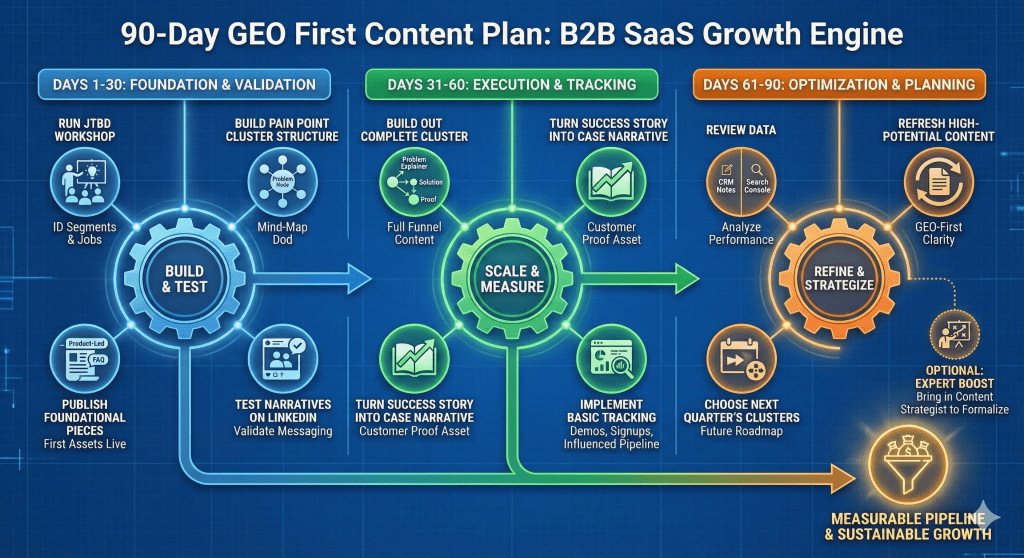
Here is how these plays stack into a realistic 90 day sprint for a lean B2B SaaS team.
Days 1 to 30
Run a JTBD workshop to identify your segments and their jobs.
Build a pain point cluster structure.
Choose your first product led article and first FAQ asset.
Publish one or two foundational pieces.
Test narratives on LinkedIn to validate messaging.
Days 31 to 60
Build out one complete cluster from problem explainer to proof.
Turn one customer success story into a case style narrative.
Implement basic tracking for assisted demos, signups, and influenced pipeline.
Days 61 to 90
Review CRM notes and Search Console data.
Refresh the high potential content pieces for GEO-first clarity.
Choose next quarter’s clusters.
Optional: bring in a B2B SaaS content strategist to formalize your system.
If you want this 90 day system tailored to your ICP, product, and GTM motion, I build GEO-first content strategies for B2B SaaS teams that need content to produce measurable pipeline.
FAQs
What is a B2B SaaS content strategy
A B2B SaaS content strategy is a structured plan that maps content to the SaaS funnel, connects jobs to be done with real pain points, and uses product led proof to drive demos and pipeline.
What does GEO-first mean in content marketing
GEO-first means designing content so humans, search engines, and AI systems can all recognize you as the most authoritative and relevant answer for a specific problem, ICP, and outcome.
How often should we update our B2B SaaS content strategy
Most teams benefit from a quarterly refresh driven by CRM data, Search Console insights, and AI Overview patterns.
 Binny Agarwal