
In the past, the goal of B2B marketing was to get traffic. It felt like a win if your blog or landing page got thousands of visitors. But that’s not enough anymore. Traffic that doesn’t affect business is just noise. It might feel good, but it doesn’t help you grow.
More marketers today are asking an essential question:
How is my content truly working?
This guide goes beyond traffic. It explores content marketing KPIs, content marketing metrics, and how to measure content ROI in B2B.
- Why Vanity Metrics Hold You Back
- What Makes a KPI Valuable in B2B
- The Funnel Approach to Content KPIs
- Operational KPIs for Content Teams
- How to Measure Content ROI
- KPI Table by Business Goal
- How to Build a KPI-Based Content Strategy
- Advanced Tips for B2B Content Teams
- Final Thoughts
- FAQs
Why Vanity Metrics Hold You Back
Let’s begin with what not to focus on.
Vanity metrics are numbers that appear impressive but do not reflect business impact. These include:
- Pageviews
- Impressions
- Social media likes
- Time on page (without context)
For example, you may publish a blog that receives 10,000 visits. That sounds great. But what if none of those visitors download your whitepaper, sign up for your newsletter, or book a demo? That traffic does not help your business.
Vanity metrics make reports look good. But they rarely help you make decisions.
What Makes a KPI Valuable in B2B
A Key Performance Indicator (KPI) is only valuable if it links directly to a business outcome.
Ask yourself:
- Does this KPI tie back to revenue?
- Can I track it reliably?
- Does it help me decide what to do next?
In B2B, good KPIs should align with the buyer journey. Content should guide users from awareness to action. Your metrics must show that movement.
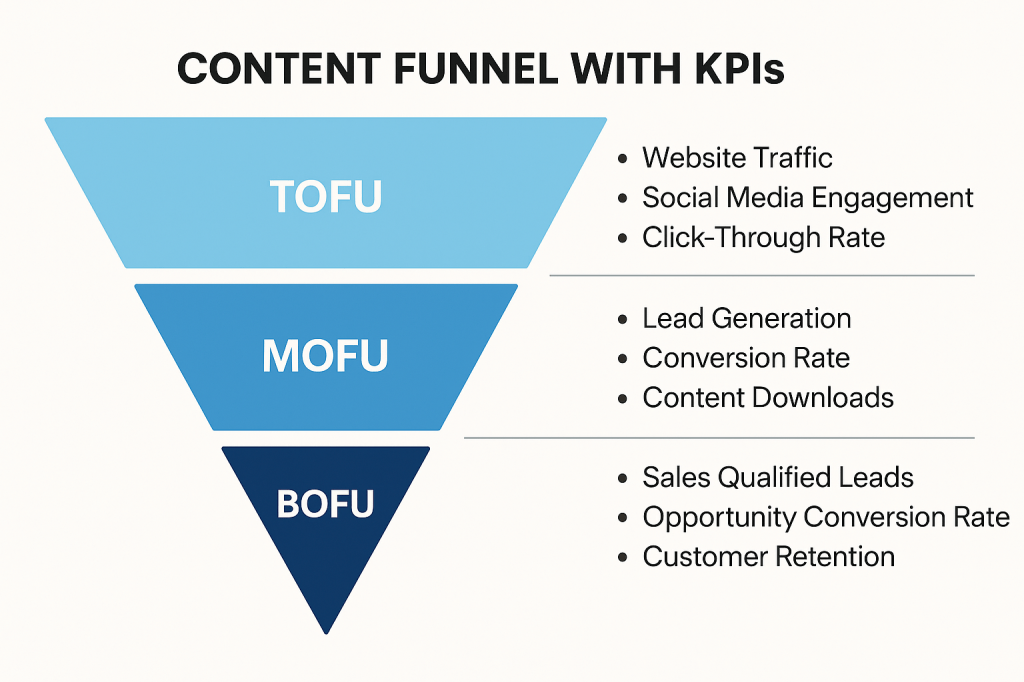
The Funnel Approach to Content KPIs
When you map content KPIs to funnel stages, they work best. It also keeps you focused on metrics that show what buyers want.
Top of Funnel (TOFU): Awareness
At this point, the goal is to be seen. But not just any attention; you want to get the right people to notice you.
Useful KPIs:
- Qualified traffic: Visitors who match your ideal customer profile (ICP)
- Click-through rate (CTR): Measures interest from search or paid ads
- Engaged time on page: Are visitors reading or bouncing?
Don’t stop at traffic. Ask: Are we attracting the right people?
Middle of Funnel (MOFU): Consideration
Now you educate and nurture.
Useful KPIs:
- Conversion rate: Percentage of visitors taking desired actions (downloads, form fills, demo requests)
- Scroll depth: Are they reading your long-form guides?
- Lead scoring impact: Does content raise the lead’s score in your CRM?
Content here should qualify and warm up leads.
Bottom of Funnel (BOFU): Decision
This is where deals happen. Your content must help close them.
Useful KPIs:
- Content-influenced opportunities: Leads who interacted with content before converting
- Sales enablement usage: How often reps use specific assets
- Assisted conversions: Content that contributed to a sale
Measure how much content helps your sales team win.
Operational KPIs for Content Teams
You also need to measure the performance of your content engine.
Key operational metrics:
- Content velocity: Pieces published per month or quarter
- Time to publish: How long does it take from a brief to publish
- Cost per content piece: Total cost vs content ROI
- Organic keyword growth: Are you gaining search visibility for key topics?
These numbers guide budgeting, planning, and team capacity decisions.
How to Measure Content ROI
Now comes the hard part. How do you prove your content generates revenue?
Attribution Models
Different models show different views of the buyer journey.
- First-touch attribution: Credits the first content interaction
- Last-touch attribution: Credits the final interaction before conversion
- Multi-touch attribution: Shares credit across all touchpoints
Use a model that reflects how your buyers behave.
Tracking Tools
To connect content to ROI, you need data from several sources:
- Google Analytics 4: Behaviour data, traffic sources, event tracking
- CRM tools (HubSpot, Salesforce): Lead sources, lifecycle stages
- Marketing automation (Marketo, Pardot): Content consumption history
- Attribution platforms (Dreamdata, Ruler Analytics): Content-influenced revenue
Use UTM tags, custom goals, and integrated reporting to track outcomes.
KPI Table by Business Goal
A simple table can help you prioritise which metrics matter based on your goal.
| Goal | Key KPIs |
| Lead generation | Form conversions, demo requests, CPL |
| Brand awareness | Branded search volume, SOV, referral traffic |
| Sales enablement | Content-assisted pipeline, usage in deals |
| Customer retention | Repeat content usage, NPS engagement |
| SEO growth | Organic keyword rankings, backlinks |

How to Build a KPI-Based Content Strategy
A strong content strategy starts with a clear business goal. Then reverse-engineer the plan.
Step-by-step:
- Define the goal: e.g., generate 50 qualified leads this quarter
- Pick the funnel stage: likely MOFU
- Choose content types: whitepapers, comparison blogs, webinars
- Assign KPIs: conversion rate, lead score, form completions
- Track and attribute: use UTMs, CRM tagging, and dashboards
You can also use this content marketing framework to map content across your buyer journey.
The goal is to create a content machine that informs, converts, and scales.
Advanced Tips for B2B Content Teams
- Build custom dashboards: Tools like Looker Studio or Databox help visualise KPI performance
- Involve sales early: Learn what content helps them close deals
- Audit your content library: Identify high-performing vs low-performing pieces
- Set content benchmarks: What is a good conversion rate for your niche?
- Score content: Rate based on production cost, engagement, and pipeline impact
KPIs are not just numbers. They are signals. Use them to improve strategy.
Final Thoughts
Traffic alone does not equal success. In B2B marketing, you win by creating content that supports the full buyer journey and delivers measurable business value.
Set clear goals. Assign smart KPIs. Track and optimise. Repeat.
That is how content drives real ROI.
FAQs
1. What are the most important content marketing KPIs in B2B?
The most valuable include conversion rate, content-assisted opportunities, demo requests, and cost per lead. These KPIs connect directly to business outcomes.
2. How do I measure content ROI?
Track each content piece from first click to closed deal using UTM tracking, CRM tools, and attribution models. ROI equals revenue influenced minus cost to produce.
3. What’s the difference between metrics and KPIs?
Metrics are raw data (e.g., bounce rate). KPIs are metrics tied to strategic goals (e.g., demo request rate). Not all metrics are KPIs.
4. How do you know if content helps close sales?
Track content in CRM journeys, use content scoring, and ask your sales team. Attribution platforms can show which pages appear in converted journeys.
5. What tools help track content marketing KPIs?
Use GA4, HubSpot, Salesforce, Semrush, Looker Studio, and attribution platforms like Dreamdata. Always connect your analytics with CRM.
References
- Content Marketing Institute – Measuring Content Marketing ROI
https://contentmarketinginstitute.com/articles/measuring-content-marketing-roi/ - HubSpot – 12 Content Marketing Metrics That Actually Matter
https://blog.hubspot.com/marketing/content-marketing-metrics - Gartner – Marketing KPI Examples and Frameworks
https://www.gartner.com/en/marketing/insights/articles/marketing-kpi-examples - Semrush – 22 Most Important SEO KPIs You Should Track
https://www.semrush.com/blog/seo-kpis/ - Dreamdata – How to Measure Content ROI in B2B
https://dreamdata.io/blog/content-roi - Moz – Metrics and KPIs for Content Performance
https://moz.com/blog/measure-content-marketing-success
 Binny Agarwal