
You have a website. You have a business. You want more people to find you online. This is the goal of every person with a website. But how do you get there? The answer is not a secret spell, but a powerful combination of two things: content marketing in SEO.
Think of your website as a new store. SEO is the sign out front, the directions on the map, and the layout of the aisles. Content marketing is the amazing stuff you put on the shelves—the products, the helpful tips, the things people actually want. You can have the best sign and directions (great SEO), but if your shelves are empty (no good content), no one will stay. And you can have the most amazing products (great content), but if no one can find your store (bad SEO), you won’t sell anything.
This guide will show you how to be an expert at both. We’ll dive deep into how to create content that not only helps people but also tells Google that you are a real authority. We’ll look at what the top experts like Ahrefs, Moz, and Backlinko have to say, and give you a clear plan to win the search rankings.
- The Big Picture: How SEO and Content Marketing Work Together
- The Foundation of a Winning Strategy: High-Quality, In-Depth Content
- The Key Pillars: How Content Drives Specific SEO Results
- Content vs. SEO Tactics: A Comparison Table
- Advanced Strategies: Building Authority with Topic Clusters
- Your Path to Dominating Search Rankings
The Big Picture: How SEO and Content Marketing Work Together
Many people think of content marketing and SEO as separate jobs. But they are a team. SEO and content marketing are two sides of the same coin.
SEO is the Strategy
It’s about understanding what people are searching for, what keywords they use, and what Google’s rules are. It’s the framework for success. SEO involves:
- Keyword Research: Finding the exact words and phrases your audience uses to search for information or products.
- Technical SEO: Making sure your website is healthy and easy for Google to crawl and understand (like site speed, mobile-friendliness, and site structure).
- On-Page SEO: Optimizing individual pages with keywords, good titles, and meta descriptions.
- Off-Page SEO: Building links from other reputable websites to yours.
Content Marketing is the Execution
It’s the actual writing, designing, and creating of the articles, videos, and images. It’s the engine that powers your SEO strategy. Content marketing involves:
- Content Creation: Writing blog posts, making videos, designing infographics, and producing podcasts.
- Content Strategy: Planning what content to create, for whom, and why.
- Content Distribution: Sharing your content on social media, email, and other platforms.
When you bring them together, you get something called a “content-driven SEO strategy.” This is a fancy way of saying you use great content to achieve your SEO goals.
For a comprehensive, step-by-step approach, you can explore a full Content Marketing Framework: A Complete B2B Guide.
The Foundation of a Winning Strategy: High-Quality, In-Depth Content
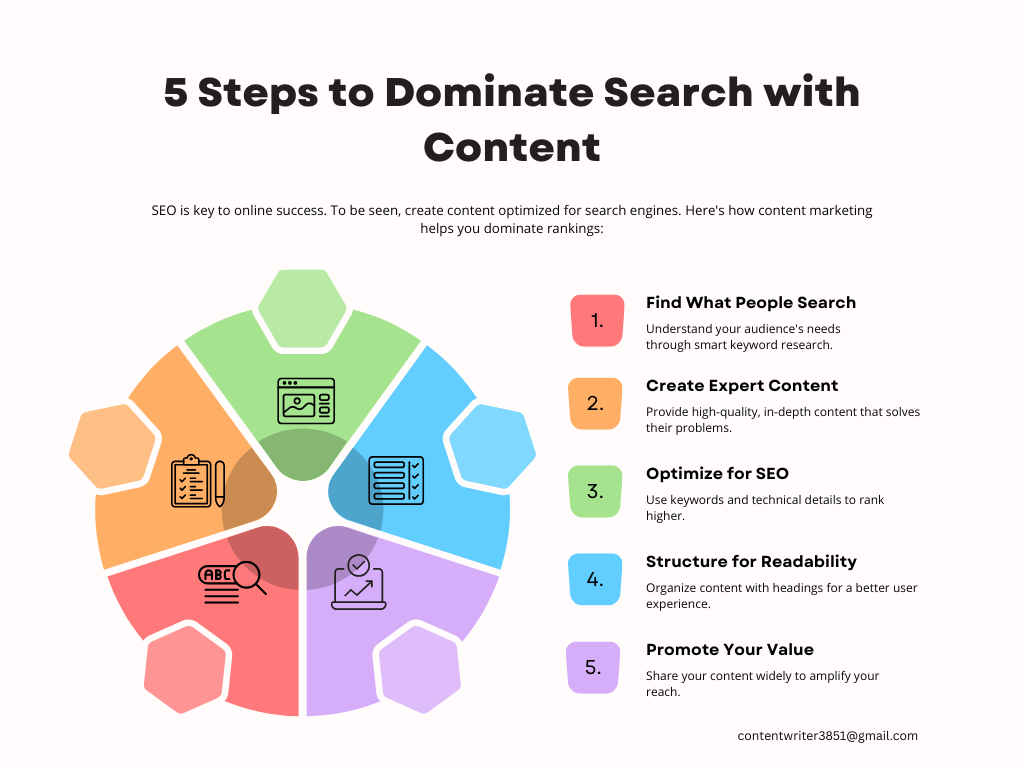
What makes a piece of content “high-quality” in the eyes of Google and your audience? The answer is simple: it needs to be helpful, detailed, and trustworthy.
Leading SEO experts have long shown that longer, more comprehensive content tends to rank better. The average word count of a page that ranks on the first page of Google is often over 1,500 words. Why? Because Google’s main goal is to give users the best possible answer to their question. A short, shallow blog post often can’t do that. A long, well-researched guide can.
How to Create This Type of Content:
- Solve a Problem: Don’t just write to write. Find a real problem your audience has and provide a clear, step-by-step solution. For example, if your audience struggles with “how to fix a leaky faucet,” your content should provide a thorough, easy-to-follow guide.
- Go Deep, Not Wide: Instead of writing 10 short posts about a topic, write one long, detailed “ultimate guide” that covers everything. This helps you build topical authority in Google’s eyes, showing that you are a true expert on that subject. When you cover a topic exhaustively, you answer many related questions in one place, making your content more valuable.
- Use Data and Facts: Support your claims with data, studies, and expert opinions. Linking to authoritative sources like Ahrefs, Moz, or even government websites can boost your own credibility and trustworthiness. This also aligns with Google’s E-E-A-T (Experience, Expertise, Authoritativeness, and Trustworthiness) guidelines, which are crucial for ranking.
- Make it Readable: Even if it’s long, your content needs to be easy to read. Use:
- Short paragraphs: Break up large blocks of text.
- Headings and subheadings: Use
<h2>,<h3>,<h4>to organize your content and make it scannable. - Bullet points and numbered lists: Great for breaking down complex information.
- Images, infographics, and videos: Visuals make content more engaging and easier to understand. Always add descriptive “alt text” to images for SEO and accessibility.
The Key Pillars: How Content Drives Specific SEO Results
Your amazing content is more than just words on a page. It’s a tool that helps you achieve specific SEO goals. Here’s a breakdown of how how content marketing helps SEO in key areas:
1. Earning Backlinks (The “Votes” from Other Websites)
Backlinks are still one of the most important factors for ranking on Google. A backlink is a link from another website to yours. Google sees these as a vote of confidence. The more high-quality votes you have, the more Google trusts you.
How to Get High-Quality Backlinks:
- Create “Linkable Assets”: These are pieces of content so good that other people in your industry want to link to them. Examples include:
- Original Research and Case Studies: If you conduct a study and publish the data, other blogs will use it and link to you as the source. This positions you as a thought leader.
- Detailed Guides and Tutorials: A comprehensive guide is a great reference. People will link to your guide when they want to explain a topic to their readers without writing it all themselves.
- Infographics and Visuals: A great visual summary of complex data can be shared a lot and helps you earn backlinks.
- The Skyscraper Technique: Brian Dean of Backlinko famously uses this technique. It involves finding content that already has a lot of backlinks, creating something even better and more comprehensive, and then reaching out to the websites that linked to the original content, asking them to link to your new, superior version. This is a proven way to get high-quality backlinks.
- Guest Posting: Writing articles for other reputable websites in your niche and including a link back to your site can also earn valuable backlinks.
2. Ranking for Keywords (The Words People Search For)
To rank on Google, your content must match what people are searching for. This is where SEO’s keyword research meets content marketing’s creativity.
How to Optimize for Keywords:
- Target the Right Keywords: Don’t just go after the biggest, most popular keywords. They are often too hard to rank for, especially for new websites. Instead, find “long-tail keywords.” These are longer, more specific phrases people use. For example, instead of “running shoes,” try “best running shoes for men with flat feet.” These are less competitive and attract a more specific, highly interested audience.
- Understand Search Intent: This is a big one. Google wants to know why someone is searching for something. Are they looking to buy something (transactional intent)? Are they looking for information (informational intent)? Are they looking for a specific website (navigational intent)? Your content must match the intent. If someone is searching for “how to fix a leaky faucet,” they want a guide, not a page trying to sell them a new faucet. Your blog post should give them the guide they are looking for.
- Natural Keyword Usage: Avoid “keyword stuffing” (repeating keywords too many times). Google is smart enough to understand synonyms and related terms. Use your main keyword naturally in your title, first paragraph, headings, and throughout the content. Also, include related keywords (LSI keywords) to show Google the full breadth of your content.
3. Boosting User Experience (UX)
Google increasingly prioritizes user experience (UX) as a ranking factor. Good content directly contributes to a positive UX.
Elements of a Good UX Driven by Content:
- Dwell Time: When people spend a long time on your page reading your content, it tells Google that your content is valuable and engaging. This is known as “dwell time.”
- Lower Bounce Rate: If visitors quickly leave your site after landing on a page, it’s a “bounce.” High-quality, relevant content keeps people on your site longer, reducing your bounce rate.
- Easy Navigation: Well-organized content with clear headings, a table of contents, and internal links makes it easy for users to find what they need.
- Mobile-Friendliness: Your content must look good and be easy to read on any device, especially mobile phones.
Content vs. SEO Tactics: A Comparison Table
To really understand the difference, let’s look at the specific actions you would take for each. They are not the same, but they are completely dependent on each other.
| Content Marketing Tactics (The “What”) | SEO Tactics (The “How”) |
|---|---|
| Writing a 2,000-word blog post on a topic | Finding the low-competition keywords for that topic |
| Creating a video tutorial on YouTube | Optimizing the video title, description, and tags with keywords |
| Making a new infographic with industry data | Adding descriptive “alt text” to the image for search engines |
| Creating a downloadable e-book for lead generation | Adding a strong meta description to make the e-book page clickable |
| Writing a series of helpful blog posts | Building a “topic cluster” to link these posts together, showing your expertise |
| Updating an old article with new information | Checking for broken links and improving website loading speed |
| Developing a detailed product review | Ensuring schema markup is correctly implemented for rich snippets |
| Hosting a webinar or online workshop | Creating a landing page with optimized content and clear calls to action |
As you can see, content is the idea and the substance. SEO is the smart way to make sure that substance gets seen.
Advanced Strategies: Building Authority with Topic Clusters
Once you have a few great pieces of content, you can take your strategy to the next level with topic clusters. This is a powerful idea from HubSpot and other experts.
A topic cluster is a group of related articles that all link to one central “pillar page.” The pillar page is a long, in-depth guide on a broad topic (like “Content Marketing”). The cluster articles are shorter, more specific posts that cover a sub-topic (like “How to find keywords for your blog”).
Why Topic Clusters Work So Well for SEO:
- Signals Expertise: It shows Google that you have a deep, comprehensive understanding of a topic, not just a few random articles. This helps you build authority. When Google sees a network of interconnected content around a central theme, it understands your site is a go-to resource for that subject.
- Boosts Rankings: When the cluster articles all link to the pillar page, they pass “link juice” and help that main page rank higher. The pillar page, in turn, helps the smaller articles rank. It’s a win-win for your entire content ecosystem.
- Better User Experience: It makes it easy for readers to find what they are looking for and discover more of your great content. If a user lands on a cluster article, they can easily navigate to the pillar page for more in-depth information or to other related cluster articles.
Your Path to Dominating Search Rankings
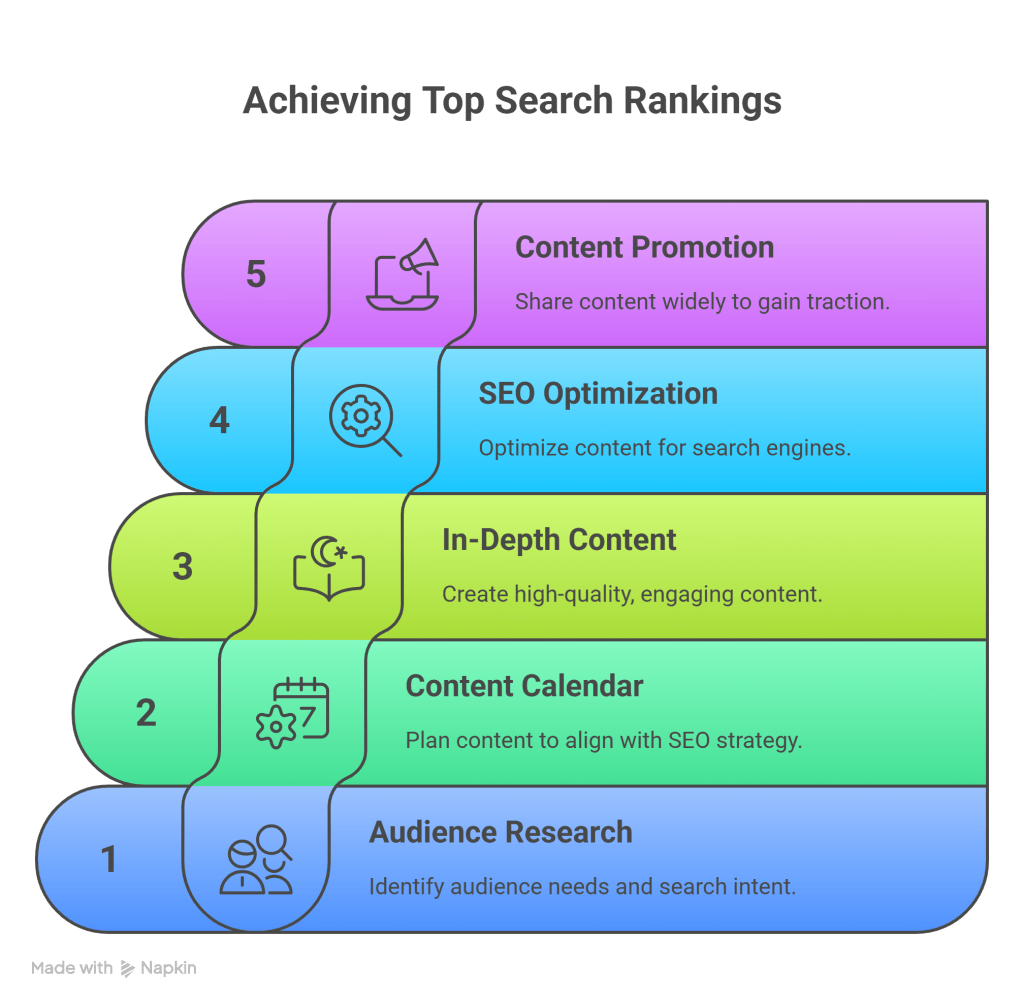
Ready to turn your website into a traffic-generating machine? Here is your step-by-step plan:
1. Research Your Audience and Their Questions
Use tools like Ahrefs, Moz, and Google’s own “People also ask” section to find out what your potential customers are searching for. What problems do they need solved? Look for keywords with decent search volume but manageable competition. Understand the intent behind those searches.
2. Create a Content Calendar
Plan out your content in advance. Decide on your pillar pages and the smaller cluster articles you will write. This makes sure you’re always creating content that serves a purpose and aligns with your overall SEO strategy. A content calendar helps you stay organized and consistent.
3. Write Amazing, In-Depth Content
Make your content the best on the internet for that topic. Don’t be afraid to go long. Use headings, lists, images, and videos to make it easy to read. Focus on providing unique value, fresh perspectives, or more comprehensive information than what’s already out there. Remember E-E-A-T: show your experience, expertise, authoritativeness, and trustworthiness.
4. Optimize for Search Engines
As you write, make sure you are using your target keywords in the title, first paragraph, headings, and throughout the text naturally. Check your on-page SEO settings (like meta descriptions, image alt text, and internal linking) to make sure everything is in place. Ensure your website is technically sound, loads quickly, and is mobile-friendly.
5. Promote Your Content Widely
Don’t just hit “publish” and wait. Share your content on social media, in your email newsletter, and reach out to other websites and bloggers who might be interested in linking to it. Engage with your audience in comments and forums. The more eyes on your content, the more likely it is to gain traction and earn those valuable backlinks.
This is not a one-time job. It’s a process. By consistently creating high-quality content that is built on a solid SEO foundation, you will build a loyal audience and earn the top spots on Google. Your website will become a trusted resource, and your business will grow.
Don’t let your competitors get all the traffic. It’s time to use content marketing in SEO to build a website that works for you 24/7.
Is your content getting the attention it deserves? Stop guessing and start a real SEO and content marketing strategy today. The top of Google is waiting for you!
Sources
- Ahrefs: Content Marketing for SEO: A 3-Step Guide
- Moz: The Beginner’s Guide to SEO
- Backlinko: SEO and Content Marketing: The Complete Guide
- HubSpot: What Is a Topic Cluster?
- Content Marketing Institute (CMI): What is Content Marketing?
- Google Search Central: SEO Starter Guide
- Search Engine Journal: How to Use Content Marketing to Improve SEO
- SEMrush: How to Create a Content Marketing Strategy
- Neil Patel: The Ultimate Guide to Content Marketing
 Binny Agarwal